Leadership Culture and Practice in dRTP Communities
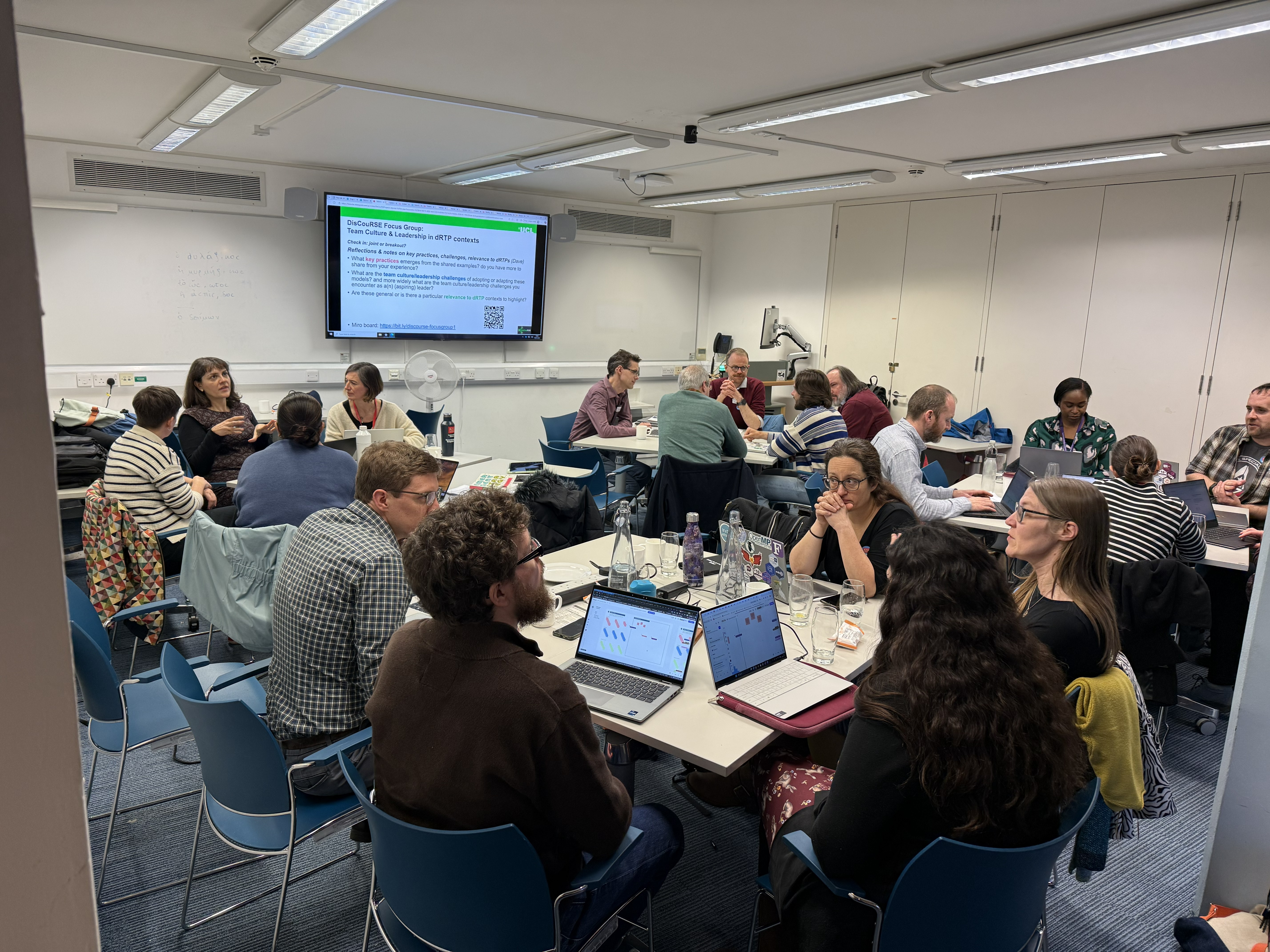
In January 2026, members of the digital Research Technical Professional (dRTP) community gathered at King’s College London for the first DisCouRSE focus group, exploring team culture and leadership in different dRTP contexts. The aim of the event was not to define a single model of leadership, nor to produce consensus. Instead, the focus group created space for something that is often difficult to do within day-to-day technical and institutional environments: to provide collective reflection on the variety of, often successful, practice in our sector. Across presentations, discussions, and facilitated sessions, participants explored how leadership is experienced and demonstrated across a wide range of dRTP settings, from established institutional RSE groups, to distributed infrastructure teams, to international open-source and community-led projects. What emerged was not a single definition of leadership, but a recognition that leadership in dRTP contexts is often highly contextual, relational, and deeply connected to culture and expectations.
Leadership and culture are inseparable:
A recurring theme throughout the day was that leadership cannot easily be separated from the environments and cultures in which technical work takes place. Leadership was discussed not simply in terms of management structures, processes or individual capability, but through everyday practices:
- How decisions are made.
- How collaboration is enabled.
- How pressure is handled.
- How trust is built.
- How contributions are recognised.
- How teams learn and adapt.
- How communities sustain themselves over time.
- How the team relates to others in their organisation.
This framing resonated strongly with the opening provocation from Katie Best, which explored the idea that team culture is not an accidental by-product of teams, but an outcome shaped through repeated leadership behaviours and organisational practices. Participants repeatedly returned to the idea that leadership models only become meaningful when they are reflected in everyday practice.
Leadership beyond hierarchy: Many of the examples discussed during the focus group challenged conventional organisational assumptions about leadership and the applicability of established best practice in the context of dRTP groups. Several presentations explored forms of distributed, emergent, and systems-oriented leadership:
- Leadership shared across communities rather than concentrated in formal roles.
- Leadership through facilitation and enablement.
- Leadership embedded within infrastructure ownership and service delivery.
- Leadership expressed through mentoring, coordination, and stewardship.
This was particularly visible in discussions around open research communities, distributed teams, and collaborative infrastructure projects, where leadership often depends less on hierarchy and more on trust, shared ownership, and community participation. Participants reflected that these forms of leadership can be highly valuable within digital research environments, but are often difficult to describe, recognise, or support institutionally. Practice, not just competencies. One of the objectives of the focus group was to reflect on how these discussions relate to DIRECT, the developing Digital Research Competencies Framework. Those conversations did not focus solely on identifying and mapping leadership skills. Instead, participants explored how leadership competencies are expressed through practice.
For example:
- Psychological safety is not simply an abstract concept, but something enacted through workload management, communication styles, and team norms.
- Stakeholder management involves translation, negotiation, and expectation-setting across different organisational cultures.
- Mentoring and team development require creating space for growth, reflection, and participation.
- Sustainable project delivery depends on practices around scoping, risk management, and continuity planning.
This raised broader questions about how competency frameworks should represent behaviours, values, and situated practice. Several discussions aligned closely with ongoing work within DIRECT around developmental pathways, practice-oriented descriptions, and value-based overlays.
The importance of reflective spaces:
Another strong theme emerging from the focus group was the value of creating dedicated spaces for reflection within teams as well as across the dRTP community. Participants repeatedly noted how uncommon it is to have opportunities for open discussion about leadership and culture in technical research environments. The event itself became a form of peer learning similar in scope to the RSE Leaders Network. It offered a space to document as well as to compare experiences across institutions, reflect on tensions and challenges, and collectively examine practices that are often invisible within formal organisational structures. This highlighted something important for both DisCouRSE and DIRECT, which is that community reflection is not separate from leadership development, it is part of it.
Open questions:
The focus group surfaced a number of ongoing questions which will continue to inform future DisCouRSE activities and the development of DIRECT.
- How could leadership practices be represented within competency frameworks?
- What forms of leadership development are most valuable within dRTP contexts?
- How can communities support reflective and distributed leadership practices over time?
- What organisational structures best support healthy and sustainable technical cultures?
- How can frameworks capture lived practice and experiences without over-standardising diverse ways of working?
These questions do not have straightforward answers and any answer is likely to be organisation specific with sector-wide commonalities. However, the discussions reinforced the importance of continuing to create spaces where the dRTP community can collectively explore them and adapt as well as adopt.
References: