Establishing promotion pathways for Digital Research Technical Professionals (dRTPs): Project outcomes!
Christine Stawitz, Project Lead at the University of Birmingham, shares the progress and outcomes of her recently completed DisCouRSE-funded project. The project explored how career progression opportunities for digital Research Technical Professionals (dRTPs) could be made clearer and more structured, particularly for those aspiring to senior technical leadership roles.
Clarifying the Pathway
The aim of the project was to improve the pathway for career progression for digital Research Technical Professionals (dRTPs) at the University of Birmingham. We aimed to achieve this by developing and pitching a career framework within the University to IT Leadership, University HR and Finance. This was intended to make the pathway clearer and more predictable for our staff, particularly those seeking to achieve senior technical leadership roles.
Defining the Issue
The research community developed around academic positions, with promotion pathways based on peer-reviewed publications and grant income. However, dRTP roles are newer, and therefore financial pathways for sustainable career progression of dRTPs are in development. For these reasons, many dRTPs are uncertain of career progression opportunities in their fields. This causes retention and recruitment problems, as universities are unable to compete with the opportunities offered to technical professionals by the private sector.
Reaching out to the Community
We conducted a series of informal interviews and workshops with dRTPs at the University of Birmingham and other institutions. From internal individual contributors, we asked what skills they would like to develop to advance their careers and how many opportunities they felt they had to grow those skills. We interviewed internal line managers and asked their opinion on the current career and promotion pathways available to staff. We asked participants from other institutions if their group had permanent roles, what percentage of their work was funded by research grants vs. core funding, and what their promotion process looked like to compare to our own group.
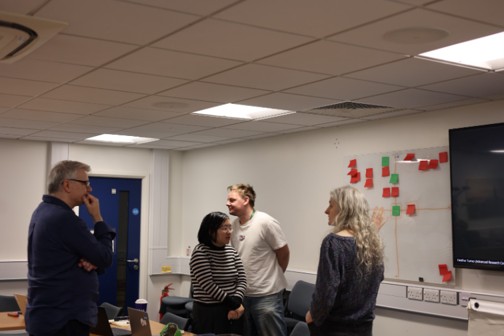
As well as collecting data internally at Birmingham, Christine also attended several external meetings including the 2026 Digital Research Infrastructure Retreat (panel session on dRTP careers), the Software Sustainability Institute Collaborations Workshop (a lightning talk on project progress and findings and discussion facilitator) as well as leading hackathon brainstorming sessions at the University of Birmingham.
Meetings were also held with line managers across our Research Software Group to identify their view of positive aspects of our career development framework and pathway and those that could be improved.
Further afield at the University, there were meetings with financial and research support staff to gain an understanding of promotion pathways in academic positions and other parts of Professional Services.
Presenting the Evidence
The data gathered at Birmingham was used by Christine to model several financial scenarios to identify a financially sustainable way to increase the cadence of promotions within our team.
Finally, results were presented to the Birmingham Advanced Research Computing (ARC) leadership and as a poster at the 2026 Research Software Engineering Conference. As a result, ARC leadership agreed to move forwards on implementing a more structured promotion process within our group as they deemed it would be feasible without higher-level approval. Additional steps requiring IT leadership approval will take longer, but Christine was approved to continue working on this using a smaller time allocation (5%) funded from core resources. The slides presented at the SSI collaborations workshop can be found on the DisCouRSE Zenodo community. We intend to publish a write-up of this work in report form soon so watch this space!
Acting on the Results
Unfortunately, our Chief Information Officer (CIO) left unexpectedly as this work was beginning, and we decided it would be best to lobby for more support from IT Services leadership once a new, permanent CIO was in place. Therefore, our initial goal of pitching to IT leadership had to be postponed.
Even though we did not ultimately pitch our improved career framework to IT Leadership and Finance, ARC leadership has agreed to implement a more structured approach to promotions and pay bumps based on standardised tables of job roles and expected capabilities across career levels. This will allow us to identify more clearly when staff are eligible for promotion and pay increases based on their performance, even if budget limitations preclude the number of promotions we might intend to offer. This further aligns our group with other parts of Professional Services that have recently implemented similar career frameworks. We will revisit the discussion with IT leadership in the future.
Christine Stawitz, Project PI, Senior Research Software Engineer
“I learned a lot about the needs of the Research Software Group with respect to career progression, and the University policies related to meeting those needs, from completing this project.”